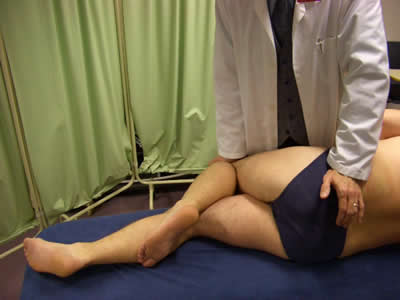
Showing posts with label Piriformis Syndrome Examination. Show all posts

Friday, August 12, 2011

Piriformis Syndrome: Quick Release from Back Pain

Piriformis syndrome is also called as back pain. It is caused by pinched muscles in your back. You can get rid of that pain by freeing up those muscles rather than having someone cutting into you. Here's how to free up your back muscles to get rid of your back pain:

Back: (do while sitting)

Place your left hand on your left leg next to your body. Place your right hand over your left shoulder, fingers over the back and the palm in the front and firmly pull down on them and hold. After 30 seconds slowly lower your body forward and to the outside of your left leg, keeping your left arm fairly straight as you do.

When you reach your lap remain there for another 10 seconds, release the pressure but rest there for another 30 seconds. Then reverse your hand positions and do your right side.

For best results relax your body first by taking a deep breath and exhaling then remain this relaxed.

OTHER RELATED INFORMATION

Please LIKE , Tweet , +1 and Share if you like this article...

Sunday, June 26, 2011

Piriformis Syndrome After Hiking

The piriformis muscle is a small muscle which sits deep in the buttocks over the sciatic nerve. It’s action is to rotate the hip out (external rotation) and extend the thigh back. When the piriformis is tight, is in spasm or on stretch, it irritates the sciatic nerve, which send pain down the back of the thigh or into the back.

When the foot pronates (rolls in), it causes the leg and knee to rotate in (internal rotation), which causes the hip to rotate in (internal rotation). This places tension on the piriformis muscle, which will then irritate the sciatic nerve. Those with tight hamstrings and tight calf muscles will have more pronation, which causes more internal rotation and stress on the piriformis muscle. The tight hamstrings also place abnormal forces on the pelvis, which increases the stress on the piriformis muscle as well.

HikingOn a hike yesterday, someone with piriformis syndrome was complaining of pain when walking uphill. The pain was in the center of the left buttock and was a deep burning pain which occurred with hill climbing and walking on uneven terrain. Both of these activities will increase the amount of pronation in the feet, increase the internal rotation at the hip, stress the piriformis and irritate the sciatic nerve. When I asked if he had placed his orthotics in his hiking boots, the answer was no. Rigid prefabricated orthotics or custom made orthotics can be very helpful for not only foot problems, but also for knee, hip and back problems because they control the amount of internal rotation at the leg, knee and hip.

OTHER RELATED INFORMATION

Please LIKE , Tweet , +1 and Share if you like this article...

Tuesday, June 9, 2009

The Chiropractic Examination For Piriformis Syndrome (Piriformis Syndrome)

Piriformis Syndrome

The chiropractic approach to diagnosing Piriformis Syndrome includes a full evaluation of your spine and pelvis and the related musculature. A functional, orthopaedic and neurological examination is also performed for Piriformis Syndrome.
  • Dysfunction in the sacroiliac joints is one contributory factor, which can lead to neuromuscular dysfunction causing weakness in the other muscles in the area.
  • Several activities are said to aggravate the pain in a Piriformis Syndrome such as walking, sitting, climbing stairs, performing squats and running, but they are so general and therefore unreliable for diagnostic purposes.
  • A possible sign of a tight piriformis muscle is having one foot pointing outwards more than the other when you lie relaxed on your back.
  • Direct palpation (touch) of the muscle reveals a taut and tender muscle, often with trigger points present causing referred pain locally or down the leg.
  • Either resisted external rotation or passive internal rotation of the hip may increase the pain.
  • Resisted muscle testing can be used to see if a tendinitis is present. But since the piriformis works in conjunction with several other muscles in the buttock area such as the Quadratus femoris, Obturator internus, Superior- and Inferior gemellus, it is difficult to be specific.
  • If there are neurological signs and symptoms present several tests are performed to rule out a disc injury. Some of these tests are modified to find out if the sciatic nerve is being affected and irritated by the taut piriformis muscle, such as Bonnet’s test.

The diagnosis is quite straight forward and there is no need for imaging such as x-ray, CT- or MRI in most cases. The diagnosis is made from the clinical tests.

When neurological symptoms are present the chiropractor will do a full neurological examination in order to identify the cause of the symptoms. Disc herniations are the most common cause, but sometimes, although rarely, more sinister causes have to be excluded. In those cases a MRI scan is requested.

Once a specific and accurate diagnosis has been made the treatment can start.

Piriformis Syndrome

OTHER RELATED INFORMATION

Please LIKE , Tweet , +1 and Share if you like this article...

Saturday, May 23, 2009

Piriformis Syndrome - Symptoms and Signs, Diagnosis and Treatment

Piriformis Syndrome

Piriformis Syndrome is compression of the sciatic nerve by the piriformis muscle, causing pain.

The piriformis muscle extends from the pelvic surface of the sacrum to the upper border of the greater trochanter of the femur. During running or sitting, this muscle can compress the sciatic nerve at the site where it emerges from under the piriformis to pass over the hip rotator muscles.

Symptoms and Signs

Symptoms of Piriformis Syndrome
A chronic nagging ache, pain, tingling, or numbness starts in the buttocks and can extend along the course of the sciatic nerve, down the entire back of the thigh and calf, and sometimes into the foot. Pain is usually chronic and worsens when the piriformis is pressed against the sciatic nerve (eg, while sitting on a toilet, a car seat, or a narrow bicycle seat or while running). Unlike piriformis pain, lumbar disk compression of the sciatic nerve (sciatica—see Neck and Back Pain: Sciatica) is usually associated with low back pain, in addition to sciatic pain down the lower extremity.

Diagnosis

Diagnosis is by physical examination. Pain with forceful internal rotation of the flexed thigh (Freiberg's maneuver), abduction of the affected leg while sitting (Pace's maneuver), raising of the knee several centimeters off the table while lying on a table on the side of the unaffected leg (Beatty's maneuver), or pressure into the buttocks where the sciatic nerve crosses the piriformis muscle while the patient slowly bends to the floor (Mirkin test) is diagnostic. Imaging is not useful except to rule out other causes of sciatic compression. Differentiation from a lumbar disk disorder is sometimes difficult, and referral to a specialist may be needed.

Treatment

The patient should temporarily stop running, bicycling, or doing any activity that elicits pain. A patient whose pain is aggravated by sitting should stand up immediately or, if unable to do so, change positions to raise the painful area from the seat. Specific stretching exercises for the posterior hip and piriformis can be beneficial. Surgery is rarely warranted. A carefully directed corticosteroid injection near the site where the piriformis muscle crosses the sciatic nerve often helps.

Piriformis Syndrome

OTHER RELATED INFORMATION

Please LIKE , Tweet , +1 and Share if you like this article...

Conservative Care For Piriformis Syndrome (Piriformis Syndrome)

Piriformis Syndrome

The piriformis muscle and the sciatic nerve
The piriformis muscle is a small muscle located in the buttocks that rotates the hip. It runs horizontally, and the sciatic nerve runs vertically directly beneath the muscle. The muscle can become tight and place pressure on the sciatic nerve, resulting in leg pain which may be difficult to distinguish from a radiculopathy (nerve pinching in the spine), which is also commonly called sciatica.

The patient’s spinal imaging studies will not show any nerve pinching, and on physical exam, motion of the patient's hip will generate the pain.

Conservative care for Piriformis Syndrome

Treatment for Piriformis Syndrome typically consists of:
  • Physical therapy that includes manual release (deep massage), along with hip range of motion exercises can help piriformis sydrome.
  • For severe cases of piriformis sydrome, the muscle may be injected with lidocaine to decrease spasm and help the patient make progress in physical therapy.
Piriformis Syndrome

OTHER RELATED INFORMATION

Please LIKE , Tweet , +1 and Share if you like this article...

Friday, May 22, 2009

Mystery or A Pain In The Behind (Piriformis Syndrome)

Piriformis Syndrome

Piriformis Syndrome is difficult to diagnose and resistant to therapy. The existence of Piriformis Syndrome has been doubted for years, but with the power of the Internet the reality of this syndrome has finally reached a tipping point. Previously, it was not even considered as a diagnosis, in others it was quickly ruled out. In others the symptoms are ascribed to "sciatica" or some other cause, even if the Piriformis Syndrome is considered as a possible cause. Often the patient has considered the possibility before the physicians, trainers, therapists and others have.

“...The existence of Piriformis Syndrome has been doubted for years. But with the power of the Internet the reality of it has finally reached a tipping point...”
Piriformis Syndrome may overlap with a variety of other problems including what McCrory et. al. have called a "deep buttock" syndrome. This includes pain in the buttock region, possibly pain in the hamstrings, occasionally pain in the back of the leg that is difficult to locate.

Piriformis Syndrome in the Behind
These symptoms of the piriformis muscle dysfunction may be caused by other clinical entities that include gluteus medius dysfunction, herniated or bulging disks, "sciatica", pelvic stress fractures and other musculoskeletal problems in this area. Scant information is available on the piriformis syndrome in lay publications, and only a little more in scientific publications. The functioning of the muscle has not been clearly defined and examined in the literature. The location of the muscle does not allow for surface EMG (electromyographical) study. It is quite difficult, if not impossible to place a deep electrode in the muscle for study purposes also.

The anatomical position of the muscle leads one to conclude that it functions in some ways similar to that of the gluteus medius. The major portion of origin of the Piriformis Syndrome is the anterior lateral portion of the sacrum and the insertion is on the upper portion of the femur.

Piriformis Syndrome

OTHER RELATED INFORMATION

Please LIKE , Tweet , +1 and Share if you like this article...

What is Piriformis Syndrome? (Piriformis Syndrome)

Piriformis Syndrome

The piriformis syndrome is a condition in which the piriformis muscle irritates the sciatic nerve, causing pain in the buttocks and referring pain along the course of the sciatic nerve. This referred pain, called "sciatica", often goes down the back of the thigh and/or into the lower back. Patients generally complain of pain deep in the buttocks, which is made worse by sitting, climbing stairs, or performing squats. The piriformis muscle assists in abducting and laterally rotating the thigh. In other words, while balancing on the left foot, move the right leg directly sideways away from the body and rotate the right leg so that the toes point towards the ceiling. This is the action of the right piriformis muscle.

Stretching the muscle often duplicates the pain. To do the piriformis stretch, lie on your back, and flex the right hip and knee. Now, while grasping the right knee with your left hand, pull the knee towards your left shoulder. This adducts and flexes the hip. In this position, grasp just above the right ankle with the right hand, and rotate the ankle outwards. This applies internal rotation to the hip and completes the stretch. Another way to do this stretch is to stand on your left foot and place the right foot on a chair, such that the right knee and hip are flexed at about 90 degrees. Now, using the right hand, press the right knee across towards the left side of the body while keeping the ball of the right foot on the same spot on the chair.

Piriformis Syndrome

OTHER RELATED INFORMATION

Please LIKE , Tweet , +1 and Share if you like this article...

Related Posts Plugin for WordPress, Blogger...